The Rolling Stones makes their TV debut this month on the popular ‘Thank Your Lucky Stars’ show together with Helen Shapiro and some other unknown (to me) bands/artists.
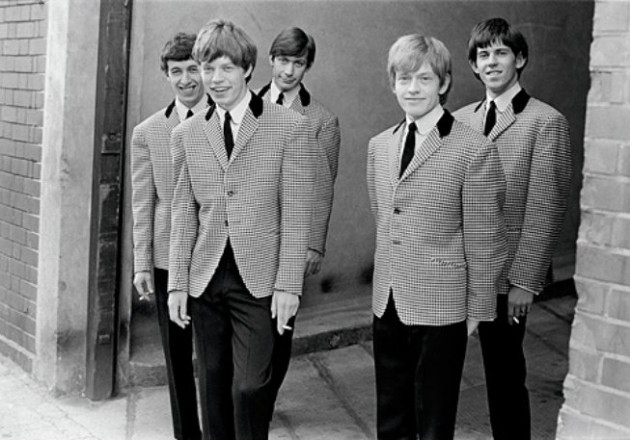
To promote their first single, «Come On», their manager Andrew Loog Oldham wanted to get them on TV as soon as possible, and a month or so after the release he got them booked to mime the single on Thank Your Lucky Stars. They wore new suits, cause Oldham figured if they showed up in their regular clothing, they wouldn’t even be allowed into the studio.
After the performance, the single eventually rose to #32 on the UK chart.
In some non-musical news, the Norwegian Football Association finally included teams from all over Norway in the Norwegian Football Cup (Fotball NM). Since 1929 the teams from up north had their own cup called Nord-Norgesmesterskapet (North Norway Cup), but from now on they can compete with all the teams based in Norway. I’m not really sure why they weren’t allowed to play until now, but I guess it could have something to do with the difficulty of traveling or something.
Some noteworthy people born this month are Karl ‘’The Mailman’’ Malone, Manu Chao, and Fatboy Slim. Karl Malone will go on to become one of the best players to ever play in the NBA, spending almost all his career at Utah Jazz. Manu Chao and Fatboy Slim will both end up as musicians known around the world.
THE ALBUMS
FATS DOMINO – HERE COMES…FATS DOMINO

Fats Domino was one of the pioneers of rock and roll music, and even Elvis once described him as the ‘real king of rock and roll’. Five of his albums have sold over a million copies, and his single The Fat Man is considered by many to be the first rock and roll single to sell over one million copies. Still, he’s not as well known as a lot of lesser artists. It’s been blamed on his shyness and modesty, but to me, that makes him even more interesting.
I believe that I’ve known Fats for many, many years, but I didn’t really listen to him until I wrote about his single Walking To New Orleans which he released back in 1960. That song really opened my eyes to this guy though, and I’ve gotten very fond of his sound and voice. However, not fond enough to check out all his releases as he has recorded and released seven albums since 1960…
«Here Comes…Fats Domino» might not have been a commercial success (I don’t really know), but it is a quality piece of work. There are no outstanding tracks or mega-hits, but every song on this album is listenable and enjoyable. I’m partial to There Goes (My Heart Again), Red Sails In The Sunset, and Land Of 1,000 Dances, however, I do enjoy the album in its entirety.
CHARLES MINGUS – THE BLACK SAINT AND THE SINNER LADY
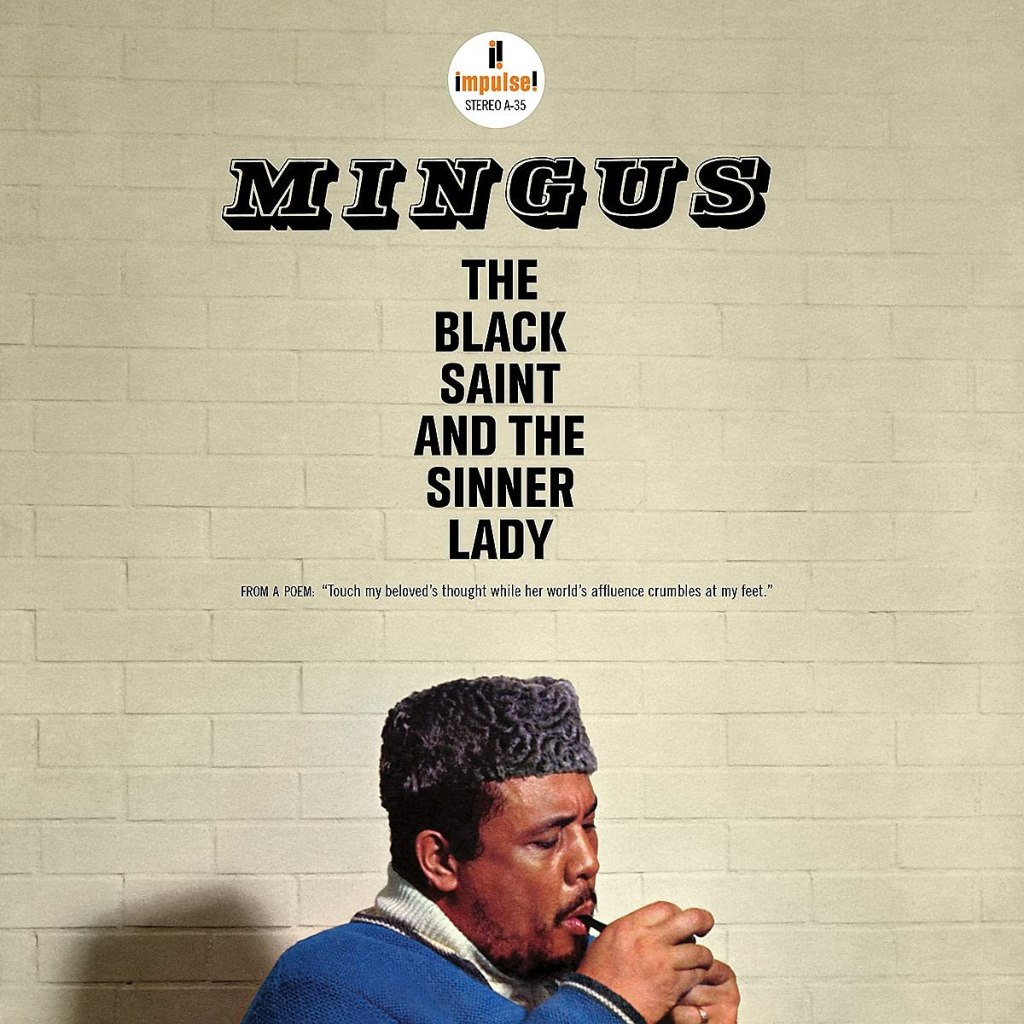
Charles Mingus is considered to be one of the greatest jazz musicians and composers in history. He started out studying trombone and cello but ended up with the double bass as he gave up on classical music and started focusing on jazz. He emerged as a prodigy, toured with with Louis Armstrong in 1943, and by 1945 he was recording in Los Angeles with a band led by Russel Jacquet.
His first popular trio, consisting of him, Red Norvo, and Tal Farlow earned some acclaim in the early ‘50s, but Mingus’ race caused problems with some of the club owners and he left the group. After that, he had a stint with Duke Ellington’s band, but the only remarkable thing from that experience is that Mingus’ notorious temper caused him to become one of the very few musicians to be personally fired by Ellington himself.
I could probably go on and on about Mingus, but I’ll save some for later releases and focus on his latest release, the masterpiece «The Black Saint And The Sinner Lady». The album has been described as ‘’one of the greatest achievements in orchestration by any composer in jazz history’’, and while I can not verify this, I can say that I totally agree. This album is badass! At a point where I’ve kinda given up on jazz, Charles Mingus revives it like a mother fucker. I can feel the self-confidence in this record, and it’s completely justified. Great fucking album. Considering there are only four tracks on this album, and there’s probably only one way to listen to it, I find it a bit difficult to highlight any tracks. But Allmusic.com doesn’t, and they recommend Track A – Solo Dancer and Track C – Group Dancers.
Pinky Tomlin released an album called «Country Boy», but he’s probably better known for his song In Ole Oklahoma, which was named as Oklahoma’s state song at some point.
«Hollywood – My Way» by Nancy Wilson becomes her highest charting album so far in her career by reaching #11 in the US. Nancy prefers to be called a song stylist (whatever that is), but I guess I would label this album as something in between easy listening and crooning. I don’t know. It doesn’t spark much joy in me though.
Bobby Darin released his fourth(!) album so far this year, and while I kinda liked «You’re The Reason I’m Living» (released in February), «Earthy» doesn’t really do it for me. It starts off well with Long Time Man and Work Song, but it doesn’t manage to keep its head above water after that. The album is Bobby’s first attempt at folk music (plus La Bamba and Guantanamera), and while he showcases great vocal diversity with this album, the material isn’t all that. The album didn’t sell very well either.
According to Wikipedia, Johnny Mathis is the third-best-selling artist of the 20th century, with more than 360 million records sold worldwide. Mathis has been described as a so-called romantic singer, and I guess that fits well with his latest release «Johnny». At this point in his career, Johnny is raking in a million dollars a year, and his career will keep going for a long time so I guess he’s filthy rich for the rest of his life because of his music and acting. Good for him, but his music isn’t for me.
The New Christy Minstrels, who were supposed to be a recording act exclusively, released their fourth album, «Ramblin’», this month. The album includes the single Green, Green which became their first hit and a million-seller. The band is described as a large-ensemble folk group, and after the success of their debut album, the group started playing live and on TV which led to a big changeover in personnel. I’m undecided about whether I like this band or not, but all in all, I guess it’s ok to listen to.
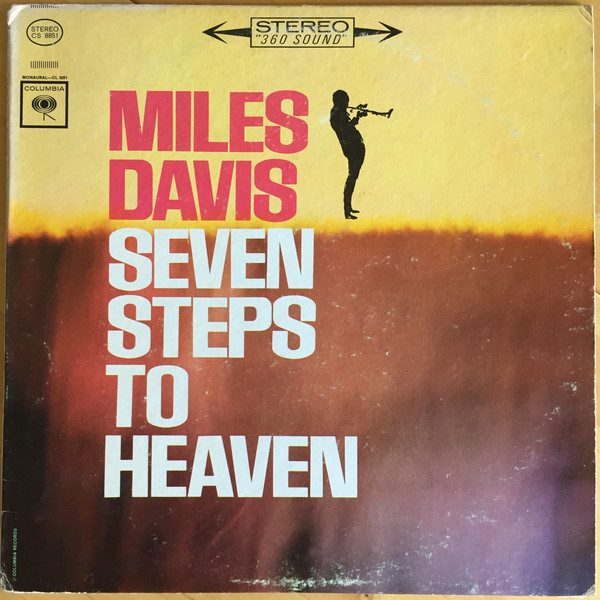
MILES DAVIS – SEVEN STEPS TO HEAVEN
Mid-1945, Miles Davis dropped out of the Juilliard School of Music. His time there was mostly spent at clubs chasing his idol, Charlie Parker, but according to himself he did learn lots of music theory, and his trumpet technique was greatly improved. Later he replaced Dizzy Gillespie in Charlie ‘’Bird’’ Parker’s quintet and participated in some recording sessions with him as well. So I guess his time at Juilliard was well spent in at least some aspects.
In 1948 Davis quit the Parker Quintet after tensions mainly due to Parker’s erratic behavior caused by drug addiction, and the fact that he didn’t get paid. During these three years, a lot of stuff happened, like a small collaboration with Charles Mingus, the start of the Miles Davis Nonet, the birth of his second child, a stint with Billy Eckstine’s big band and Dizzy Gillespie’s, alcohol and cocaine, and he declined an offer from Duke Ellington. Now Miles was ready to go at it alone, as a leader.
His nonet remained active until 1949, and after signing a contract with Capitol Records they did a couple of recording sessions which didn’t sell much, but at least influenced the ‘’cool’’ style of jazz. They kept recording for Capitol until 1950 and released a dozen singles, which were eventually compiled and released as «Birth of the Cool» in 1957.
But we’re here for his latest release, «Seven Steps To Heaven». After he didn’t finish the recording of an album called «Quiet Nights» in 1962 (due for release in December 1963), Miles returned to club work. But he suffered a lot of medical problems that year and lost a lot of work because of it. Another repercussion was that his entire band quit. Miles had to hire a completely new band to fulfill the bookings he had, and record the sessions that would become «Seven Steps To Heaven».
The are both up-tempo tracks and ballads on this record and after the first session, Miles decided to record the up-tempo ones again as he was not satisfied. He hired another band to finish those but stayed with the first artists for several years after the release of this record. This album is much more, I guess available than the Mingus album I wrote about earlier, but that actually makes it a bit duller to my ears. It’s a great piece of work, but I feel it’s missing something to put it above the rest. However, the album did become Miles’ most successful on the Billboard chart as it rose to #62, so if you need any more convincing you can check out Baby Won’t You Please Come Home.
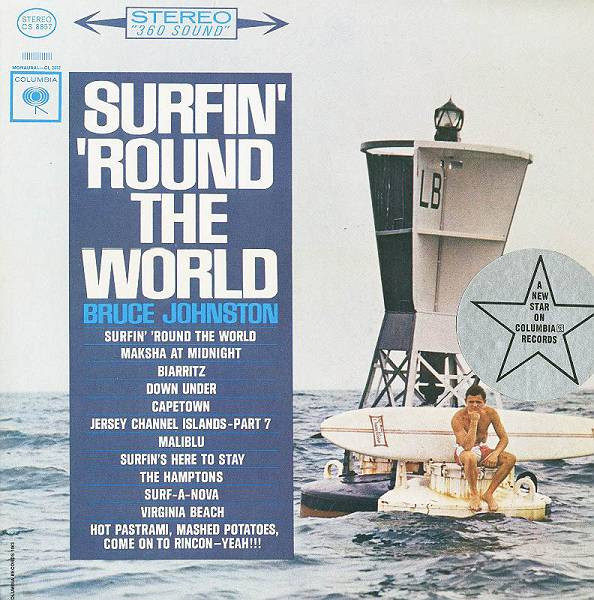
BRUCE JOHNSTON – SURFIN’ ‘ROUND THE WORLD
I guess we could say that Bruce Johnston’s career started in 1959 when he arranged and played on his first hit record, the Sandy Nelson single Teen Beat. He was still in high school at this point, and before this, he had studied classical piano and switched to more contemporary music when he started high school. This change led him to work with artists like Phil Spector, The Everly Brothers, Richie Valens, and Eddie Cochran.
His debut album, «Surfers’ Pajama Party», was released last year, and before that, he dabbled in some producing and what-not. Johnston is probably best known as a member of the Beach Boys, but he won’t be joining them until 1965, so right now he’s on his own. And I gotta say that he holds his own pretty well, cause there are some pretty cool tracks on his latest album, «Surfin’ ‘Round The World».
Bruce is obviously into surf music at the moment, which is also probably why he was hired by the Beach Boys at some point. Compared to the other surf bands out there right now, I believe he’s doing better than most. At least when it comes to material. Tracks like Down Under (which my two-year-old son loves), Biarritz, Jersey Channel Islands, Pt. 7, Virginia Beach, and Malibu are probably my favorites, where all of them manage to make me wanna rock out. He has a really cool guitar sound on some of these tracks as well. I’m not sure if this record hit the charts at all, but in the surf-rock genre, I’d say he’s up there at the top.
ROY HAYNES WITH BOOKER ERWIN – CRACKLIN’
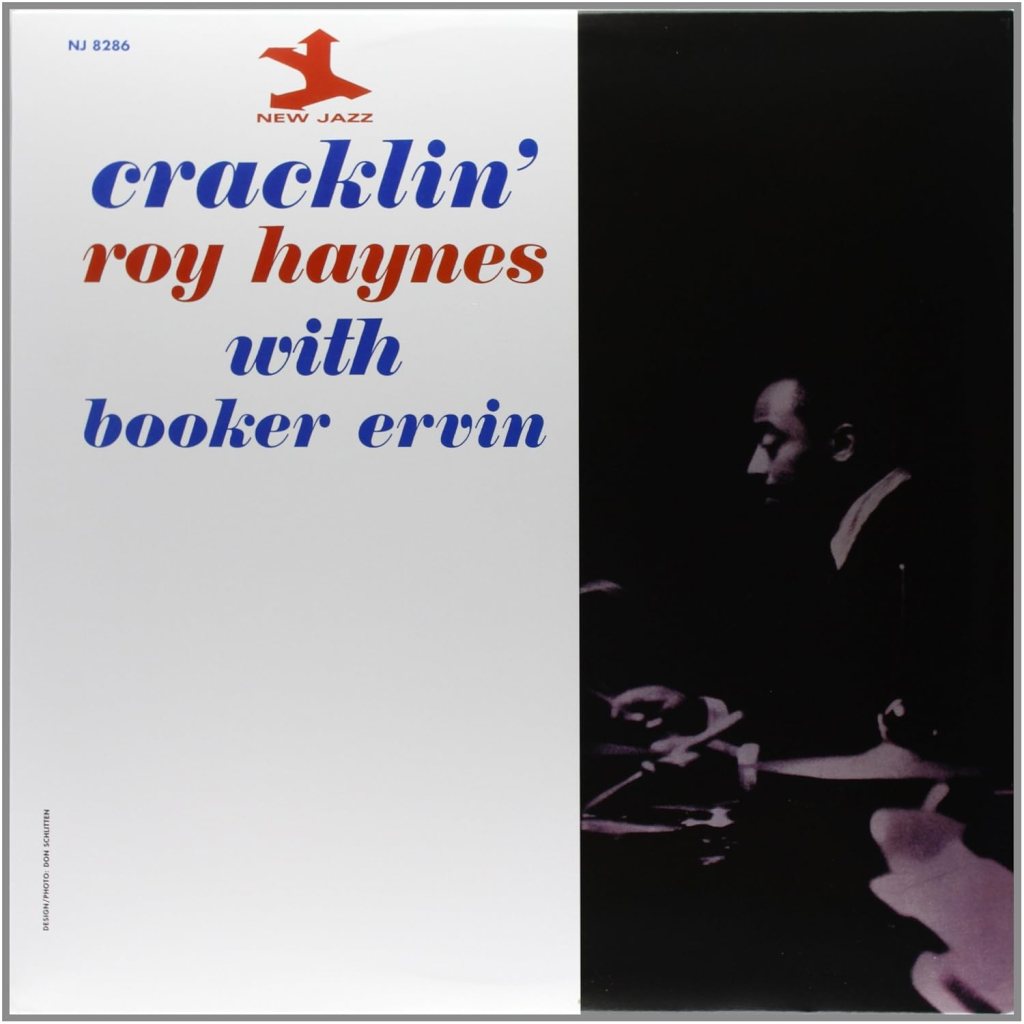
Roy Haynes is a jazz drummer. He is actually one of the most recorded jazz drummers of all time and has recorded with artists like Charlie Parker, Miles Davis, Thelonious Monk, Art Blakey, and Kenny Burrell. He has also played the drums on albums I’ve written about here like Ray Charles’ «Genius + Soul = Jazz», McCoy Tyner’s «Reaching Fourth» and John Coltrane’s «Impressions».
He was also the voice of the Jazz Nation Radio 108.5 in Grand Theft Auto IV, which is kinda cool as I’ve played that game a lot.
Even though Haynes is the leader of this album, most of the focus is put on Booker Erwin. And from what I’ve read it’s not unusual for Haynes to highlight another soloist on his albums. Which makes sense I guess, cause no matter how important the drums are I wouldn’t wanna listen to an album packed with drum solos and whatnot. Booker Erwin plays the tenor saxophone and has played with Charles Mingus from 1958 up until now. He does a good job on this album and adds the necessary soulfulness to make this album worth listening to. I like the album, but I’m not blown away or anything. I am partial to Dorian and Honeydew as far as the tracks go.
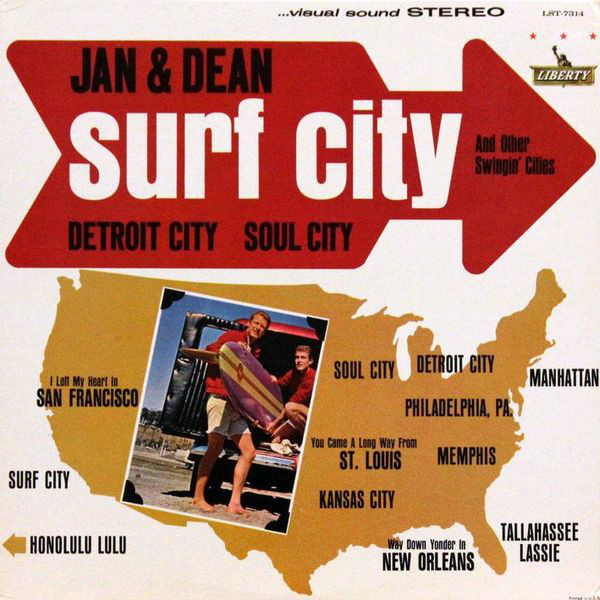
JAN & DEAN – SURF CITY AND OTHER SWINGIN’ CITIES
Jennie Lee was released in 1958 and was supposed to be Jan & Dean’s debut single. Dean, however, had to join up with the Army Reserves, so Dean had to record it with Arnie Ginsburg who wrote the song. The song became a surprise hit for Jan and Arnie stopping at #8 on the Billboard chart. The duo released three singles together before Dean returned from the Army in 1959.
Their first hit came the same year with the song Baby Talk reaching #10 and scored a series of hits after that as well. It was around this time that they met and performed with the Beach Boys, which in turn got them into the surf sound. This takes us to 1963, when the duo will hit their peak. It all starts with their hit single Surf City (released and written about in May), which is also the song this album is built around.
«Surf City And Other Swingin’ Cities» is a kind of concept album where all the songs are about a city, real or fictitious, which turns into a kind of Lonely Planet book for surfing (-ish). Surf City and Honolulu Lulu, both released as singles, are probably the best tracks on the album, their version of Kansas City is cool, and I like Philadelphia, P.A as well. So I guess even though this album isn’t an instant classic, it still has its moments.
Amos Milburn was big in the ‘40s and ‘50s, with hits like Hold Me Baby (on this album as well) and Chicken Shack Boogie. He’s also known for recording a lot of drinking songs, like One Scotch, One Bourbon, One Beer which is also present on his newest album «The Return of the Blues Boss». The album is ok, and I guess it’s a fitting goodbye to his solo career as this is his last album. But I have no idea if this is a compilation or if his older songs are re-recorded for this album, and I guess that’s for someone else to figure out.
Joe Pass started out playing in swing bands when he was in high school, and after he served in the military he became a drug addict and served some time in prison. So it wasn’t until the ‘60s that he could really make a pass at music. Being a jazz guitarist isn’t something that appeals to me, but this guy sure knows how to work a guitar. His latest release «Catch Me» has gotten some great reviews and from what I understand he will go on to become one of the most notable jazz guitarists of the 20th century.
The Tymes, a soul vocal group, releases their debut album «So Much In Love» and with it their two biggest hits. The title track, So Much In Love, was released as a single this summer, and Wonderful! Wonderful! will be released as a single in August. The latter one is a remake of Johnny Mathis’ version from 1957 and The Tymes’ version is quite nice. So Much In Love is co-written by George Williams from The Tymes and it is a beautiful song! So Much In Love will also top the charts at some point in 1963. It’s a pretty good album altogether.
Art Blakey & The Jazz Messengers deliver a pretty cool jazz album with their «Buhaina’s Delight». Compared to Amos Milburn and Joe Pass I would say that this one is worlds apart. Buhaina is what Art named himself when he converted to Islam back in the day (he’s not a practicing Muslim anymore as I understand) and the name follows him even though he doesn’t use it anymore. The album is a great lesson in hard bop, and definitively worth a listen. Check out Reincarnation Blues, Bu’s Delight, and Backstage Sally.
After their initial success with Shout in 1959, The Isley Brothers have only had one hit with the similar sounding Twist and Shout in 1962. Their latest album «Twisting and Shouting» is devoid of hits and seems to find the brothers struggling to figure out their sound. It has some good material, but none worth mentioning.
JOHN COLTRANE AND JOHNNY HARTMAN – JOHN COLTRANE AND JOHNNY HARTMAN
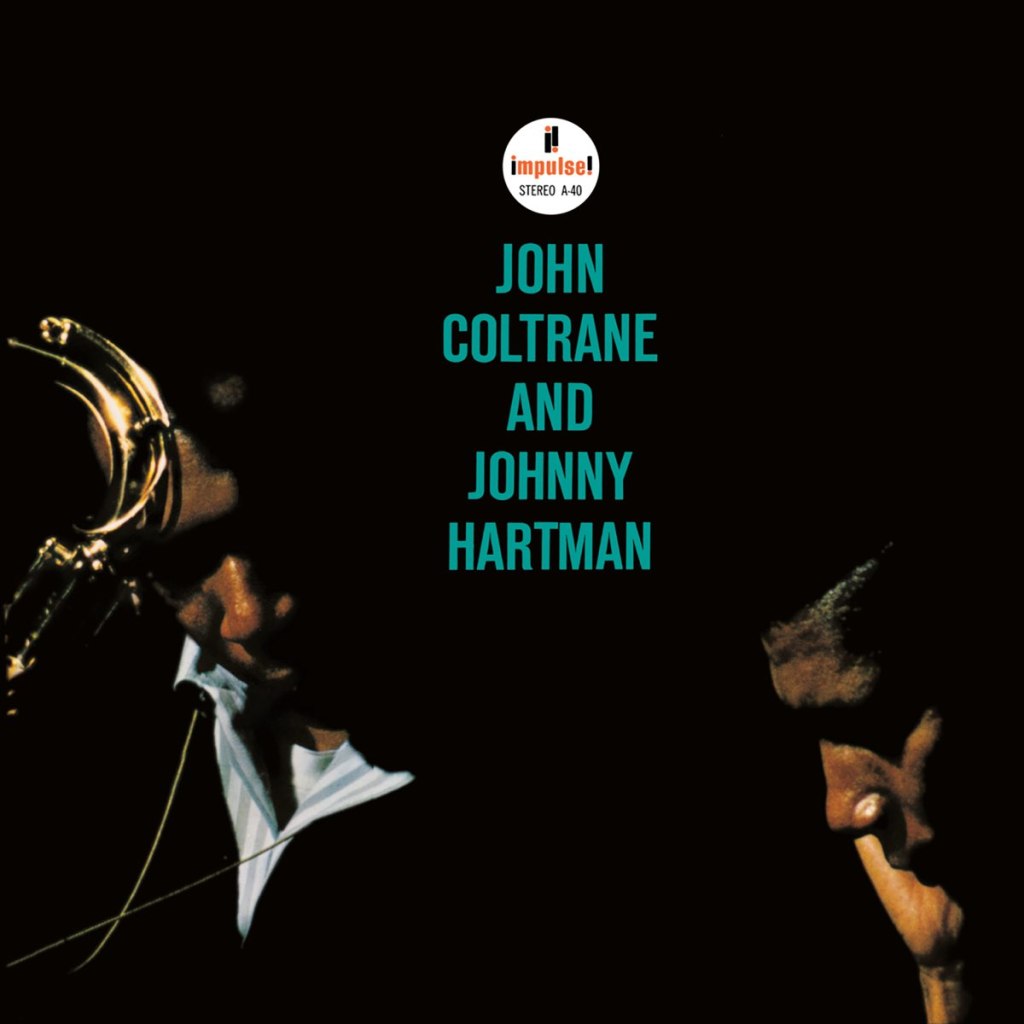
Johnny Hartman wasn’t convinced that he and John Coltrane would be a good fit, mainly because he didn’t consider himself a jazz singer, but he was encouraged by Coltrane’s manager to go see him play live at Birdland, New York, and when Hartman, Coltrane, and McCoy Tyner went over some songs after the club was closed, he was convinced.
For Hartman, it would turn out to be a very good decision as this album will be the one he’s really remembered for. Almost all of the reviews I’ve read consider this album to be amazing, and it’s even called a landmark album for Coltrane by some. The last ballad album by Coltrane I wrote about didn’t sit right with me, and while I’ll gladly acknowledge that this one is beautiful I gotta say that it is in many ways difficult to listen to. I believe if Hartman was removed and the music stood alone I could have enjoyed it more. But that’s just because I can’t handle jazz singing…yet?
Coltrane wanted to record another album of ballads and just felt that Hartman would be the right man for the job. So he made it happen. This is Coltrane’s only album with a vocalist, and considering that it is revered by many I guess he made the right choice. Good for him, and Hartman.
UNKNOWN RELEASE DATE
Mongo Santamaria released a live album called «Mongo At The Village Gate» which didn’t seem to get much attention. At least, I can’t seem to find any specific information about it. The album isn’t all that either, maybe a bit boring, and what really sticks with me is the fact that whenever he announces the next track there doesn’t seem to be any reaction from the crowd which kinda gives you the feeling of being in attendance and feeling sorry for the guy, maybe even a bit embarrassed.
«Along Came John» is organist John Patton’s debut album and it was released at some point in 1963. Compared to Jimmy Smith, who plays the same instrument, I’d say John falls short. But there sure is something with that instrument which just sounds great. I did like the track Spiffy Diffy quite a lot, and all in all, it’s a pretty decent album.
Back in March the artist Olatunji released an album called «High Life!», and now (or some other time in 1963) Solomon Ilori puts out his «African High Life». I’m not sure what kind of high life these African dudes refer to, however, the Allmusic.com review of Ilori’s album does mention traditional African highlife music, so I guess that’s a thing. Solomon plays the drums, like Olatunji, and he’s from Nigeria, like Olatunji, and this album should also be considered as a breath of fresh air with its African rhythms. I kinda like it, as it sure lifted my spirits today. Check out tracks like Ise Oluwa and Jojolo (Look At This Beautiful Girl).
Jimmy Smith is finally back without a big band behind him. Unfortunately, it’s not with a bang. «Rockin’ The Boat» did hit the album chart, peaking at #62, but the bang is missing in the sense that it feels like a very slow album. Actually, compared to John Patton’s release, I’d say that «Along Came John» is the best of these two. What’s more interesting is that John Patton plays the tambourine on three tracks here.
While I’ve seen «The Cry!» being described as an avant-garde jazz album, I would’ve thought that avant-garde would be a lot more difficult to listen to. But Prince Lasha Quintet feat. Sonny Simmons is anything but that. It’s actually a cool album and pretty easy to enjoy even though it is pretty different from the other jazz albums I’ve favored.
THE SINGLES
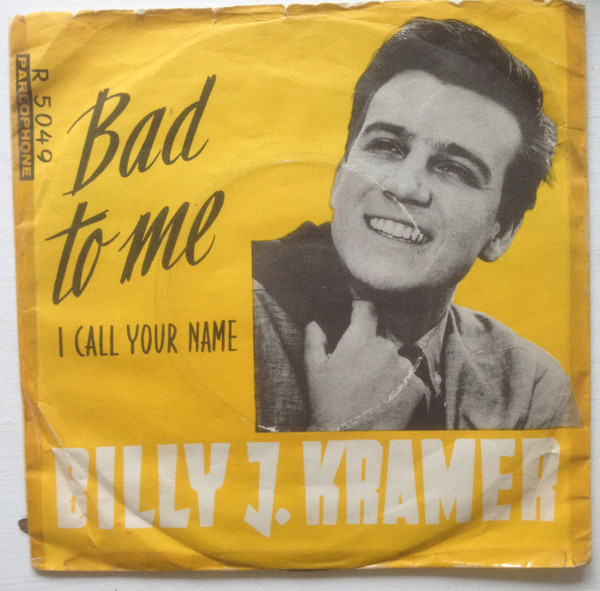
Billy J. Kramer is out with his second single, and yet again it’s a Lennon/McCartney composition. Bad To Me was written by John and Paul in the back of a van at some point, and it is the first composition by the duo to reach the US Top 40 recorded by another artist than The Beatles. The B-side is yet another Lennon/McCartney song, I Call Your Name. Billy J. is gonna have a hard time messing stuff up with songs written by these dudes, so naturally they sound pretty good. He does give them a sort of Cliff Richard feel though. The single made it to #1 in the UK.
Considering Billy’s first two singles are comprised of only Lennon/McCartney songs, I would say that he has made a fascinating career choice. A successful one, but still interesting. Cause the way I see it he’s just a Beatles cover artist, to be honest, and the fact that the Beatles isn’t really the biggest artist around yet makes it even more interesting. Did Billy know that these boys were gonna take over the world? Anyway, I don’t think I know of any other cover artists that have had the success Billy has had so far, so good for him.
Heat Wave was written by the songwriting team Holland-Dozier-Holland and released this month by Martha Reeves and the Vandellas. It’s a great song that made it all the way to #1 on the R&B chart, and #4 on the Hot 100. The song even helped popularize both the artist and the songwriting team. This single is easily the best one I’m writing about this month, and the praise it received is definitively well deserved.
The B-side, A Love Like Yours (Don’t Come Knocking Everyday), is absolutely part of what makes this single great. I believe it is the simple, but super catchy, chorus that makes this song awesome. It will also be covered by artists like Ike & Tina Turner, Dusty Springfield, and the Animals in the future.

We’re also treated to a classic by The Angels this month. My Boyfriend’s Back is a song I believe everybody has heard at some point, and most of them can probably sing along to it. It was actually recorded by The Angels as a demo for The Shirelles, but the song ended up being released as it was. The song went to #1 on the Hot 100 chart where it stayed for three weeks, and #2 on the R&B chart. It does sound a lot weaker than I remembered it, but it’s still impossible to not enjoy. The Angels, however, will never get bigger than this.
It is paired with a song called Love Me Now which is nice.
Brenda Lee released a song called I Wonder, which was originally released in 1944 by Pvt. Cecil Grant. It’s been released by at least four other artists before, and every single one of them did really well on the charts. Brenda took it to #25 on the Hot 100, which makes her version the poorest of them all if we only take the charts into account. I’m not a big fan of Brenda’s ballads, but I don’t actually hate this one.
I like the B-side better though. My Whole World Is Falling Down is written by Bill Anderson (he released the awful hit song Still some time ago) and Jerry Crutchfield and the chorus is supposedly based on a nursery rhyme called London Bridge Is Falling Down. The B-side went to #8 on the Adult Contemporary chart and #24 on the Hot 100 chart, which means that the B-side was more successful.
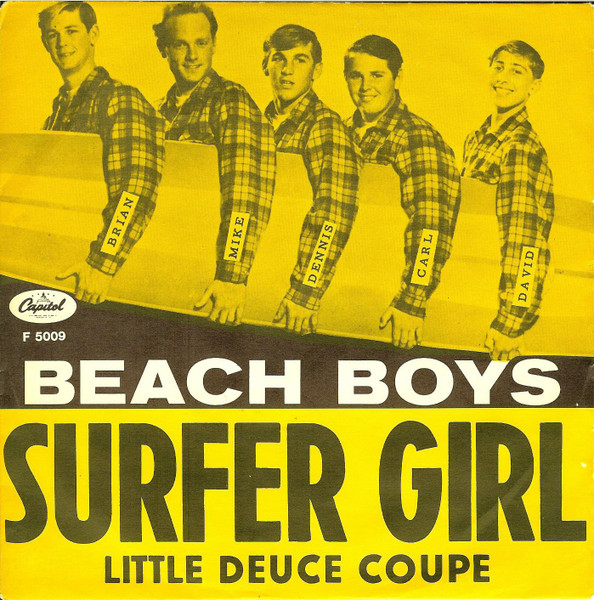
The fifth single from the Beach Boys, Surfer Girl, follows their big hit Surfin’ U.S.A. (and the album «Surfin’ U.S.A.»). I guess it’s fair to say that compared to that one, Surfer Girl is a lot less exciting. It’s a ballad based on Dion and the Belmonts’ version of When You Wish Upon A Star, with Brian Wilson on vocals. Of course, he wrote and produced it as well. So yeah, this one might not be very exciting, but it is a pretty nice tune. It also did quite well on the Hot 100 chart, stopping at #7. This is the first single from the upcoming album «Surfer Girl».
The B-side is also taken from the upcoming album. Little Deuce Coupe is also written and produced by Brian Wilson (music), and co-written (lyrics) with a guy called Roger Christian, who was a local radio station DJ. Little Deuce Coupe is a car song, supposedly referring to a Ford Model 18, but even though the lyrics are completely uninteresting to me, I do really like the track. It rose to #15 on the Hot 100 chart and became the Beach Boys’ highest charting B-side.
Then He Kissed Me is probably the best-known single from The Crystals and is produced by Phil Spector as usual. Spector has also co-written the track together with Ellie Greenwich and Jeff Barry. It peaked at #6 in the US and #2 in the UK. ‘The Wall of Sound’ is apparent here, and it does give it an edge if you ask me.
It’s paired with a song called Brother Julius which is an instrumental tune. And I find that pretty interesting considering that none of the girls in The Crystals plays any instruments…but since The Wrecking Crew plays the instruments on the A-side, maybe they’re doing it here as well.

Mickey’s Monkey has been described as ‘’one of our biggest records ever in life’’ by the lead singer of the Miracles, Smokey Robinson. I guess that has something to do with it reaching the Top 10 at both the R&B chart and the Hot 100 chart. It also helped popularize ‘’The Monkey’’ as a national dance craze in the US. I’m not a fan of this dance craze thing, as I’ve mentioned numerous times before, but this one is a bit different. First of all, it’s a great tune, and second, it’s for a dance I’ve never heard of and I’ve not heard of any other artists trying to capitalize on it (there might be others, but at least I haven’t been exposed to them). It’s also a bit unusual for the Miracles to record a song not written by their main man Smokey Robinson, but the songwriting team of Holland-Dozier-Holland has done a good job pairing the Miracles with this one.
The B-side was a part of their album, «The Fabulous Miracles», released in February this year, and Whatever Makes You Happy is co-written and produced by Smokey.
Manfred Mann started their recording career this month with their first single Why Should We Not?. The band was formed in London by Manfred Mann and Mike Hugg, and they signed with the record company His Masters Voice in March this year. The single did not chart, but it is a very likable bluesy instrumental track.
The B-side is a version of the song Brother Jack (Fader Jakob in Norwegian) and even though it took me a while, I actually ended up liking the tune quite a lot. It’s very simple and chill, but it does give the song a new kind of life that I never thought would be possible as I’ve sung this song a million times in my childhood and sing it with my son now.
UNKNOWN RELEASE DATE
The Searchers started out as a skiffle group in Liverpool back in ‘59, and they took their name from a Western movie called, you guessed it, «The Searchers». Like The Beatles, they played shows for some time over in Hamburg, Germany, and after they got back home managed to score a record deal with Pye Records. This is their debut single, and they decided to start off with a version of Sweets For My Sweet, which The Drifters originally released back in 1961. The track will go all the way to #1 in the UK, which will establish them as contenders in the Merseybeat explosion.
The B-side is a number called It’s All Been A Dream, written by drummer/singer of The Searchers, Chris Curtis. It’s a pretty cool tune, but I can’t find any meaningful information about this track.
Bombora is the Atlantics’ biggest hit. An Australian surf rock band that was, as far as I can see, pretty big in their native country. The single did get some international success as well, but I’m not sure how accurate the Wikipedia page for this band is. The song is cool, though pretty similar to all the other surf hits that have been released so far.
Booker T. & the MG’s are still mainly a session band working as the house band for Stax Records, but that doesn’t stop them from becoming a band in their own right. They still just got that one album («Green Onions», released last year), but they’ve got some singles coming out this year. One of them is called Home Grown, and it’s a great piece of music. It didn’t chart anywhere as far as I know, but it’s still awesome. Booker T. & the MG’s has saved instrumental music from The Shadows and The Ventures in my opinion, by adding the soul that we all needed.
It’s paired with a track called Big Train, which is just as good as the A-side. Both songs are composed by the group themselves, and it proves that they know more than just playing their instruments to perfection. Both songs will appear on their next album.
The Vanguards formed in 1961 in Bærum, Norway, and released their first singles in 1963. So far they have been focused on instrumental tracks, but this time we’re treated to one song with lyrics. This is the third release from them I’m writing about. En liten gylden ring and Twist Little Sister make up their newest release, and they are absolutely in the same vein as their previous ones.
THE CHARTS
Billboard Top 10 Singles Chart
Week 1 (July 6, 1963)
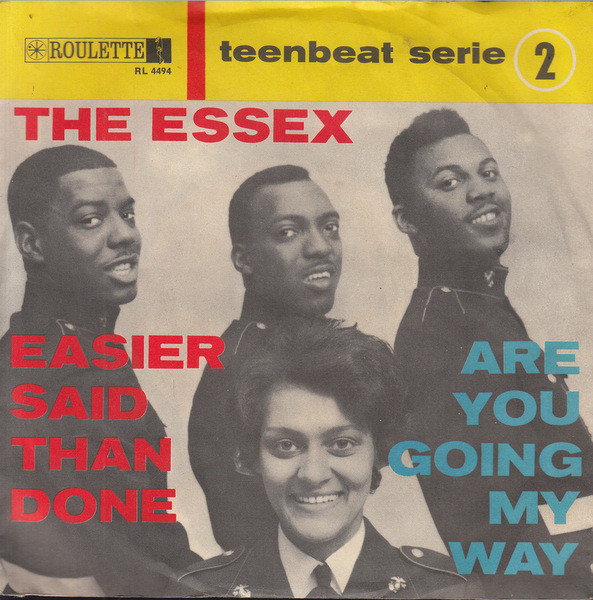
- Easier Said Than Done – The Essex
- Sukiyaki – Kyu Sakamoto
- Blue On Blue
Week 2 (July 13, 1963)
- Easier Said Than Done – The Essex
- Surf City – Jan & Dean
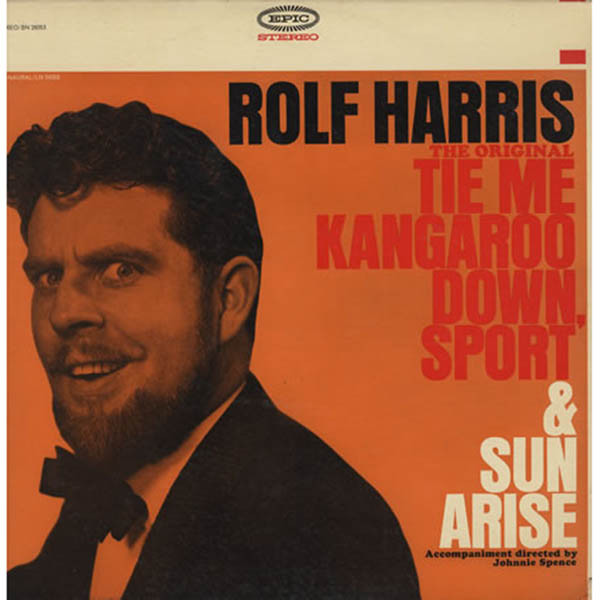
- Tie Me Kangaroo Down, Sport – Rolf Harris
Week 3 (July 20, 1963)
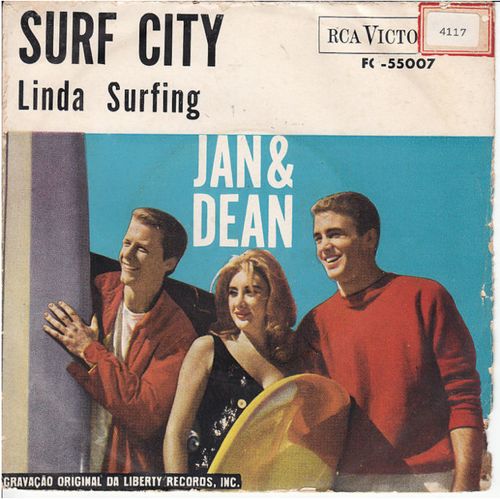
- Surf City – Jan & Dean
- Easier Said Than Done – The Essex
- So Much In Love – The Tymes
Week 4 (July 27, 1963)

- Surf City – Jan & Dean
- So Much In Love – The Tymes
- Fingertips Pt. 2 – Little Stevie Wonder
The only new addition to the Top 10 this month is a terrible song called Tie Me Kangaroo Down, Sport by Australian singer Rolf Harris. It’s a novelty number that was originally released in 1960 but re-recorded in 1963. The original version charted in Australia, New Zealand, and the UK, while this new one makes it in the US. I don’t know why though, but hey, there’s obviously a big market for this kind of music in the early ‘60s.
COUNTRY CHART
Roy Clark charts for the first time in his career when The Tips of My Fingers reaches #10 on the Country chart. It was written and released by Bill Anderson in 1960, taking it to #7 himself, and it will be recorded by a handful of other artists through the years. It’s a country ballad that sounds good when Roy sings it, and even though it is a bit too slow and polished for my taste, it’s still kinda nice.
You Comb Her Hair is a song released by George Jones, and written by Hank Cochran and Harlan Howard. It’s a tune about the love a father has for his daughter (I was a bit confused before I figured that out) and George takes it into the Top 10 this month.
Jim Reeves enters the Top 10 with his single Guilty. A classic country ballad about heartache which is maybe a bit too boring for me. I can’t find a lot of information about this one, so I guess I’ll just leave it there.
The last one to enter the Country Top 10 this month is Sonny James with The Minute You’re Gone. A country ballad about heartache written by his fiddle player, Jimmy Gateley. It stopped at #9 but also reached #95 on the Hot 100 chart.
R&B CHART
Brook Benton is probably the guy I’ve written about the most here in the Charts section. That implies a couple of things I guess. First of all the fact that he releases a lot of great music that people like, second; that he’s not noteworthy enough for me to add him to my list of released music (mostly because he doesn’t come up anywhere), and lastly I would say that maybe he hasn’t gotten all the cred he deserves? I don’t know about that last one, but I do find it a bit strange. Anyway, he’s up here in the R&B Top 10 with the song My True Confession, and I can’t really find any information about that one either. Compared to the other Benton tracks I’ve written about, I believe this is the one I have liked the least. It is a nice little tune though.
The last one to get some attention this month is Ray Charles with the song No One. It’s a great tune as I would have expected from Ray, but I don’t believe I’ve ever heard it before. It was originally released by Connie Francis in 1961, but Ray has the most successful version of the two. It was written by Doc Pomus and Mort Shuman, and Ray took it to #9 on the R&B chart, #21 on the Hot 100, and it charted in the UK.
Petter Milde
This Band Could Be Your Life
 This Band Could Be Your Life